Quick Answer: What Does a Compliant School Backpack Actually Require?
A school backpack sold in the United States must meet the Consumer Product Safety Improvement Act (CPSIA) if it is designed or intended primarily for children 12 and younger. In practice that means lead content below 100 ppm in accessible substrate materials, lead in surface coatings below 90 ppm, phthalate content below 0.1 percent for eight restricted plasticizers in any plasticized component, a tracking label sewn into the bag, and a Children's Product Certificate (CPC) issued by the importer based on third-party testing at a CPSC-accepted laboratory. Small-parts assessment under 16 CFR 1501 applies when the bag is intended for children under three, and sharp-point and sharp-edge tests apply to hardware on any children's product.
For the European Union, a backpack for under-14s is treated under the General Product Safety Regulation (GPSR) and, when it has play value or is clearly marketed as a toy-like character bag, under the Toy Safety Directive 2009/48/EC using the EN 71 series. Even when EN 71 is not legally triggered, most EU retailers require EN 71-3 migration testing for accessible materials plus REACH Annex XVII compliance for phthalates, azo dyes, PAHs, cadmium, nickel release in metal parts, and SVHC declarations. California adds Proposition 65 warning obligations for listed chemicals such as DEHP, lead and certain PAHs, which affects any bag sold into the state regardless of where the brand is headquartered.
The practical takeaway from the factory floor is that compliance is not a certificate you buy at the end. It is decided when the bill of materials is written. The zipper puller alloy, the PVC name-tag window, the reflective tape adhesive, the screen-print ink and the foam in the back panel each carry their own chemical profile. If any one of them is sourced without a chemical spec, the finished bag cannot pass without expensive re-sourcing.
Scope: What This Guide Does and Does Not Cover
This guide is written for brand owners, importers, wholesale distributors, school-uniform suppliers and marketplace sellers who source student and kids backpacks from a manufacturer in China and need to place them legally in the US, EU, UK, Canada or Australia. It covers chemical restrictions, physical and mechanical safety, labeling, documentation, testing strategy, cost planning and RFQ structure for soft-sided school bags, kids daypacks, toddler bags, trolley school bags and lunch-bag sets that ship with them.
It does not cover general adult laptop or travel backpacks, which fall under general product safety rules without the children's product tests. It also does not attempt to replace legal advice or a laboratory's formal test plan. Regulations change; limits, test methods and exemptions quoted here reflect the published standards referenced in the Official Sources section and should be confirmed with your notified body or accredited laboratory before you sign off a production order.
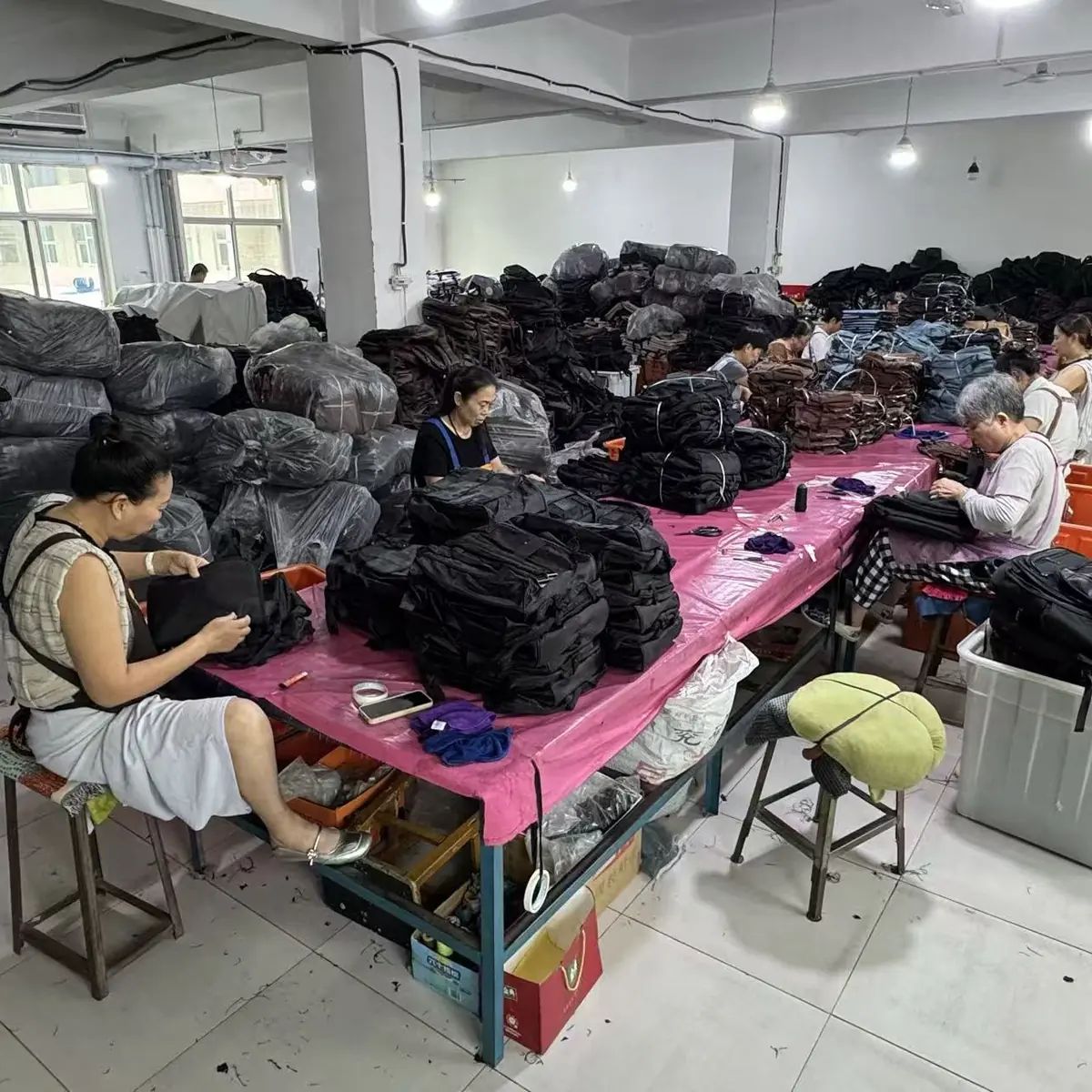
Throughout the article DUTA describes how compliance decisions are made inside a bag factory that has produced school backpacks for 20 years. Where a limit or process is program-specific, the text says so instead of quoting a single universal number.
Why School Backpacks Are Regulated Differently From Adult Bags
Regulators separate children's products from general consumer goods for two reasons. First, children mouth, chew and handle products far more than adults do, so chemical migration from surfaces into saliva is a realistic exposure route rather than a theoretical one. Second, a child's body mass is lower, which means the same absorbed dose of lead, cadmium or a phthalate produces a proportionally larger effect. The combination makes the acceptable limits for a kids backpack far tighter than for an adult commuter bag built from the identical fabric.
The consequence for sourcing is an age-grading decision that must be made before design freeze. A backpack printed with a cartoon character, sized for a 6-year-old torso and sold in a back-to-school aisle is a children's product in every major market. A plain 30-litre daypack marketed to high school students may or may not be, depending on the jurisdiction's age cut-off and how it is advertised. When the answer is ambiguous, the safest commercial decision is to build to the children's standard, because the cost delta at the bill-of-materials stage is small compared with a recall.
A recall does not just remove inventory. It triggers marketplace account suspension, retailer chargebacks, mandatory consumer notifications and, for CPSIA violations, civil penalties that the CPSC adjusts annually for inflation. In our experience with brands that have lived through one, the reputational damage among school procurement buyers lasts several selling seasons.
How Age Grading Is Determined in Practice
The CPSC applies a four-factor test: the manufacturer's stated intent, the packaging and marketing, whether the product is commonly recognized as being for children, and the Age Determination Guidelines. Size is highly persuasive. A back panel shorter than roughly 40 cm with strap adjustment ranges suited to a child's shoulder width will be judged a children's product even without any cartoon graphics. Retailers often go further and classify anything in the back-to-school category as a children's product to simplify their own compliance audits.
For the EU, the Toy Safety Directive applies when a product is designed or intended for use in play by children under 14. A plush animal backpack with a detachable toy head is a toy. A plain school bag is not, but GPSR still requires it to be safe, and retailers treat EN 71-3 as the de facto benchmark for chemical safety of any product for under-14s.
United States: CPSIA, ASTM F963 and CPSC Rules for Kids Backpacks
CPSIA is the umbrella statute. It establishes lead limits, phthalate limits, third-party testing, certification and tracking-label requirements for all children's products. The specific tests a school backpack needs depend on its components, but a typical program includes the items in the table below. Each line is tested by a CPSC-accepted laboratory and the results support the Children's Product Certificate that must accompany the shipment.
| Requirement | Regulation | Limit / Method | Backpack Components Affected |
|---|---|---|---|
| Total lead in substrate | CPSIA Sec. 101 / 16 CFR 1500.87-.91 | 100 ppm; CPSC-CH-E1001/1002/1003 | Zipper pullers, buckles, D-rings, grommets, PVC windows, coated fabric |
| Lead in surface coatings | 16 CFR 1303 | 90 ppm; CPSC-CH-E1003 | Screen prints, heat transfers, painted hardware, printed lining |
| Phthalates (DEHP, DBP, BBP, DINP, DIBP, DPENP, DHEXP, DCHP) | 16 CFR 1307 | 0.1% each; CPSC-CH-C1001 | PVC name-tag window, plasticized trims, soft PVC patches, coated zipper tape |
| Small parts | 16 CFR 1501 | Small-parts cylinder | Detachable charms, zipper pulls, buttons on bags for under-3s |
| Sharp points / edges | 16 CFR 1500.48-.49 | Sharp-point tester | Metal hardware, rivets, trolley frames |
| Tracking label | CPSIA Sec. 103 | Permanent, sewn-in | Interior label with manufacturer, location, date, batch |
| Children's Product Certificate | 16 CFR 1110 | Issued by importer | Whole product, referencing all above tests |
What a Children's Product Certificate Must Contain
The CPC is not issued by the factory. It is issued by the US importer of record, based on test reports the factory or the importer commissioned. It lists the product, each applicable rule, the importer's contact details, the manufacturing date and location, the test date and the laboratory. Retailers and marketplaces routinely request the CPC and the underlying reports at onboarding. A manufacturer that can hand over a complete test package on request saves the importer weeks of back-and-forth.
- Identify the product by style number, colorways and any variants covered by the same test package.
- Cite every applicable rule by CFR section; missing one is a technical violation even if the product would pass.
- Record the date and place of manufacture, which must match the tracking label sewn into the bag.
- Name the CPSC-accepted laboratory and the report numbers so a buyer can verify them independently.
- Keep the CPC on file for at least five years and provide it to distributors and retailers on request.
ASTM F963 and When It Applies
ASTM F963 is the US toy standard. It becomes mandatory when a backpack has play value: a plush animal design with a stuffed head, a bag with a built-in game panel or rattle, or a set that bundles a toy. Plain school bags are not toys and do not require F963 testing, but many buyers ask for it anyway on character-licensed products. If F963 is in scope, expect heavy-metal migration on eight elements, flammability, and additional mechanical tests on stuffed components.
European Union and United Kingdom: EN 71, REACH and GPSR
In the EU, chemical safety for children's bags rests on two pillars. REACH Regulation (EC) 1907/2006 Annex XVII sets restrictions that apply to every article regardless of age, while the Toy Safety Directive and its harmonized standard EN 71 set additional requirements for products with play value. Since the General Product Safety Regulation took effect in December 2024, every consumer product placed on the EU market must also have a responsible economic operator established in the EU, a documented risk assessment and traceable identification on the product or packaging.
The UK retained near-identical requirements after Brexit under UK REACH, the Toys (Safety) Regulations 2011 and the General Product Safety Regulations 2005, with UKCA marking replacing CE where marking is required. For a school backpack the practical difference is mainly the address of the responsible person and the marking used; the test methods and limits align closely.
| Substance Group | Legal Basis | Limit | Where It Appears in a Backpack |
|---|---|---|---|
| Phthalates DEHP, DBP, BBP, DIBP | REACH Annex XVII entry 51 | 0.1% by weight, sum, in plasticized material | PVC windows, soft patches, coated zipper tape, PU coatings |
| Cadmium | REACH Annex XVII entry 23 | 0.01% in plastics; 0.01% in coatings | Colored PVC, pigments, metal plating |
| Lead | REACH Annex XVII entry 63 | 0.05% in articles that can be mouthed by children | Zipper pullers, buckles, decorative hardware |
| Nickel release | REACH Annex XVII entry 27 | 0.5 ug/cm2/week for prolonged skin contact | Metal buckles and strap adjusters touching skin |
| Azo dyes releasing listed amines | REACH Annex XVII entry 43 | 30 mg/kg | Dyed polyester and nylon fabric, webbing, thread |
| PAHs (8 listed) | REACH Annex XVII entry 50 | 0.5 mg/kg each in children's articles | Rubber, black plastics, EVA foam, recycled content |
| 19 soluble elements | EN 71-3:2019+A1:2021 | Category-specific migration limits | All accessible materials on toy-like bags |
| Formaldehyde | EN 71-9 / national rules | Method-dependent | Resin-finished fabrics, adhesives |
EN 71-3 Categories and Why Fabric Is Tested as Category III
EN 71-3 divides toy materials into three categories: dry, brittle or pliable materials; liquid or sticky materials; and scraped-off materials. Textiles, coatings, plastics and paper fall into Category III, which has the most permissive migration limits because scraping simulates a lower exposure than swallowing a powder. The nineteen elements include aluminium, antimony, arsenic, barium, boron, cadmium, chromium III and VI, cobalt, copper, lead, manganese, mercury, nickel, selenium, strontium, tin, organic tin and zinc. Chromium VI and organic tin have the tightest limits and are the most frequent failures on cheap black dyes and stabilized PVC.
GPSR Responsibilities for Non-EU Brands
A brand outside the EU cannot place a school backpack on the EU market without an economic operator inside the EU who takes responsibility for the technical file, cooperates with market-surveillance authorities and whose name and postal address appear on the product or packaging. Marketplaces enforce this at listing level. Factories are increasingly asked to leave space on the care label for this information or to sew it in before shipping, which needs to be agreed before label artwork is approved.
California Proposition 65 and State-Level Chemical Laws
Proposition 65 requires a clear and reasonable warning before exposing a person in California to any of roughly 900 listed chemicals above a safe-harbor level. For backpacks, the listed chemicals that arise most often are DEHP and other phthalates in PVC, lead in hardware and prints, cadmium in pigments, BPA in some polycarbonate hardware and certain PAHs in black rubber or foam. Unlike CPSIA there is no product-level exemption for meeting a federal limit; a bag can pass CPSIA and still require a Prop 65 warning if a component exceeds a safe-harbor exposure level.
The realistic paths are either to test components to the enforcement-driven thresholds used by the plaintiff bar, typically 300 ppm lead in accessible components and 1000 ppm for each listed phthalate in materials that contact skin, or to apply the short-form warning label to the product and packaging. Most brands selling into US mass retail choose to design the chemistry out because a Prop 65 warning on a kids product depresses conversion and invites retailer questions.
Beyond California, Washington's Children's Safe Product Act requires reporting of chemicals of high concern in children's products, and several states have begun restricting intentionally added PFAS in textiles. PFAS matters for backpacks because C6 and C8 fluorocarbon DWR finishes have historically been the default water-repellent treatment on polyester shells. Specifying a PFAS-free DWR in the fabric spec is now the low-risk default for any program with US distribution.
Physical and Mechanical Safety: Straps, Hardware, Cords and Load
Chemical compliance gets most of the attention because it is what laboratories test and certificates cite, but the injuries regulators actually record on school bags are mechanical: strangulation risk from long cords, finger entrapment in buckles, cuts from burrs on metal hardware and, most commonly, musculoskeletal complaints from bags that are too heavy or badly fitted. A compliance program that ignores these is incomplete.
Drawstring and cord hazards are governed in the EU by EN 14682 for children's clothing; it does not legally cover bags, but retailers apply its logic to any cord a child could loop around the neck. The working rule inside our sample room is that no free cord end on a bag for under-7s may exceed 75 mm when the cord is fully extended, and cord locks must be captive. Hydration-tube ports and headphone ports are designed as flat grommets rather than protruding loops for the same reason.
Hardware needs a burr and sharp-edge inspection on every production batch, not just the sample. Die-cast zinc pullers and plastic buckles from a different mould cavity can carry flash that the approved sample did not. Trolley school bags add a further set of checks: pinch points on the telescopic handle, wheel-axle retention and the stability of the loaded bag on a 10-degree incline.
Ergonomic Load Guidance and What It Means for Design
Pediatric and physiotherapy bodies in the US, UK and Australia converge on a guideline that a loaded school bag should not exceed 10 to 15 percent of the child's body weight. That is not a legal limit for the manufacturer, but it drives the design features school procurement buyers look for: an S-curve padded shoulder strap at least 50 mm wide for ages 6-12, a sternum strap to stop straps sliding, a padded back panel with a laptop or book sleeve positioned close to the spine, and a compression system so a half-empty bag does not sag away from the back.
Empty-bag weight is a specification item. A 20-litre school bag for lower primary should weigh under 500 grams empty; a 30-litre upper-primary bag under 750 grams. Every 100 grams saved on the empty bag is 100 grams of textbook capacity the child carries without exceeding the guideline. This is where fabric selection ties directly back to compliance: a 600D polyester shell with a 210D lining is often the right compromise, and moving to 900D or 1680D for a kids bag adds weight without a durability benefit at the loads a child actually carries.
Strap Attachment Strength and Test Methods
Shoulder strap anchors are the most common structural failure on school bags and the easiest to specify. DUTA's internal standard for kids school bags is a static load of 15 kg per strap anchor held for 60 seconds with no seam slippage over 3 mm and no fabric tear, followed by a cyclic test of 5,000 lift cycles at 8 kg. Buyers who need a laboratory reference can cite ASTM D1683 for seam strength of the anchor seam and ISO 13935-2 for seam breaking force of the strap-to-body join.
The construction that reliably passes is a folded webbing tab bar-tacked through the shell fabric plus a 600D reinforcement patch, with a second bar-tack at 90 degrees. Single-row straight stitching through the shell alone will pass a static pull on a fresh sample and fail in cyclic testing or after six months of use.
Material-by-Material Compliance Risk Map
Compliance failures cluster around a small number of components. Knowing where risk sits lets you allocate testing budget where it matters and specify safer alternatives before sampling rather than after a failed report. The table below is drawn from the failure patterns we see across school backpack programs; it is a risk map, not a guarantee, and every lot still needs to be verified.
| Component | Typical Material | Primary Risk | Failure Frequency | Lower-Risk Specification |
|---|---|---|---|---|
| Name-tag window | Soft PVC | Phthalates, cadmium, lead | High | Phthalate-free PVC with DOTP or TPU film; or eliminate window and use printed panel |
| Zipper puller | Die-cast zinc alloy | Lead, cadmium, nickel release | High | Certified lead-free zinc alloy or nylon puller; request mill cert per batch |
| Screen print / heat transfer | Plastisol or PU ink | Lead in pigment, phthalates in plastisol | Medium-high | Water-based or phthalate-free PU ink; avoid metallic and fluorescent pigments |
| Reflective tape | Glass-bead on PVC or PET | Phthalates in PVC carrier | Medium | PET-backed reflective film certified to EN 17353 and phthalate-free |
| Back-panel foam | EVA or PE foam | PAHs, formamide, azodicarbonamide residues | Medium | Low-PAH EVA with test report; PE foam where firmness allows |
| Shell fabric | 600D polyester, PU coated | Azo dyes, formaldehyde, PFAS from DWR | Low-medium | Oeko-Tex Standard 100 Class I or II fabric; PFAS-free DWR |
| Webbing and thread | Polypropylene or polyester | Azo dyes on dark colors | Low | Bulk-dyed polyester webbing with azo test report |
| Plastic buckles | POM or nylon | Generally low; sharp edges from mould flash | Low | Branded buckle with material declaration; 100% visual burr check |
| Rubber or silicone patches | Silicone, TPR | PAHs in black TPR | Medium | Platinum-cured silicone; avoid carbon-black TPR |
| Trolley frame | Aluminium, steel, ABS | Sharp edges, pinch points, chrome VI on plating | Medium | Anodized aluminium; capped tube ends; chrome-free plating |
The PVC Decision
PVC is the single largest compliance variable on a school backpack. It appears in clear windows, coated fabrics, piping, patches and the tape on some water-resistant zippers. Standard flexible PVC is plasticized with DEHP or DINP, both of which are restricted. Phthalate-free PVC formulated with DOTP or citrate plasticizers exists and passes readily, but it costs more and factories that have not been told to use it will default to the cheaper compound. The specification must state 'phthalate-free PVC, DEHP/DBP/BBP/DIBP/DINP/DIDP/DNOP each below 0.1 percent, test report per lot' or, more simply, eliminate PVC from the bill of materials and use TPU or coated polyester wherever a clear or coated component is needed.
Building a Testing Strategy That Controls Cost
Third-party testing is where compliance budgets are lost. A full CPSIA and EN 71-3 package on every colorway of every style at every production run is unaffordable for most programs, and the regulations do not require it. Both the CPSC and EU market-surveillance practice allow component-based testing, material equivalence across colorways and periodic re-testing rather than per-shipment testing. Understanding the rules lets you cut laboratory spend by more than half without weakening the certificate.
The first lever is component testing. Instead of testing a finished bag, which forces the laboratory to test every distinct material on it, test each material once at the supplier level. A zipper vendor's lead and phthalate report on a puller alloy covers that puller on every style that uses it. A fabric mill's Oeko-Tex or azo report covers the shell on every bag cut from that roll. The bag factory then assembles a component test file and the finished-product test is reduced to confirming the assembly did not introduce anything new, typically the print and any adhesive.
The second lever is material equivalence. CPSC rules allow a single test to cover multiple colorways when the substrate is identical and only the pigment differs, provided the pigments themselves are tested or the darkest and most saturated color is used as the worst case. On a 6-colorway school bag program this typically reduces fabric testing from six samples to two.
The third lever is periodic testing. CPSIA requires a reasonable testing program with re-testing at least annually, or whenever there is a material change. It does not require testing every purchase order. A factory that keeps a stable, documented bill of materials with locked component suppliers can run one annual test package and support twelve months of shipments from it.
Suggested Test Plan by Program Stage
The sequence below is how DUTA structures testing for a new school backpack program shipping to both the US and EU. The cost figures are deliberately omitted because laboratory pricing varies by accreditation body, country and volume; request quotes from at least two CPSC-accepted laboratories with EU ISO 17025 accreditation.
- Design stage: collect existing component reports from zipper, fabric, foam, webbing and print-ink suppliers. Reject any component without a current report or a supplier willing to provide one.
- Pre-production sample: run a screening test on the finished sample with XRF for lead and cadmium plus a phthalate screen on all plasticized parts. Screening is fast and cheap and catches the obvious failures before bulk material is bought.
- Bulk material arrival: verify the incoming lot of the two highest-risk components, typically PVC parts and metal hardware, against the approved sample by XRF or supplier lot certificate.
- Production sample: commission the full regulatory package on one finished bag per distinct material set, covering CPSIA, EN 71-3, REACH Annex XVII and any buyer-specific requirements. This report supports the CPC and the EU technical file.
- Annual or on material change: repeat the full package. Any change of supplier, alloy, ink, foam grade or coating chemistry resets the clock.
Choosing a Laboratory
For US distribution the laboratory must appear on the CPSC list of accepted third-party conformity assessment bodies for the specific test. For the EU the laboratory should hold ISO/IEC 17025 accreditation with EN 71-3 and REACH methods in scope. The large multinational laboratories meet both requirements and issue reports that every retailer recognizes; regional Chinese laboratories can be significantly cheaper for screening and component testing while still holding CPSC acceptance. A common cost-effective split is regional laboratory for screening and component verification, multinational laboratory for the annual certification package.
Labeling, Marking and Documentation Requirements
A compliant bag with incomplete labeling is still non-compliant, and labeling errors are the most common reason for customs holds and marketplace de-listings because they are visible without a laboratory. Four label elements need to be planned into the artwork stage.
The CPSIA tracking label must be permanently affixed, which for a soft bag means sewn in, and must carry the manufacturer or private labeler name, the location and date of production, and cohort information such as a batch or run number that lets a specific unit be traced to a specific test report. It may be combined with the care label. Printed labels that wash out or peel do not qualify.
Country-of-origin marking is required by US customs under 19 CFR 134 and must be legible, conspicuous and permanent; 'Made in China' sewn into the same label satisfies it. The EU GPSR requires the manufacturer's name and postal address and, for non-EU manufacturers, the EU responsible person's details, plus a type, batch or serial number. The UK mirrors this with a UK address.
Fiber content and care labeling follow the Textile Fiber Products Identification Act in the US and Regulation (EU) 1007/2011 in the EU when the bag is marketed with fabric composition claims. Many school bags avoid the obligation by not stating composition, but retailers frequently ask for it anyway, so it is simpler to include a compliant fiber label from the start.
- Sewn-in tracking label with manufacturer, production location, month and year, and batch code.
- Country of origin in English, permanent, on the same or adjacent label.
- EU responsible person name and postal address for EU shipments; UK address for UK shipments.
- Age grading statement where the product is not intended for under-3s, for example 'Not suitable for children under 36 months' with the reason if small parts are present.
- Prop 65 short-form warning on product and packaging if the design-out strategy is not adopted for California.
- Care symbols per ISO 3758 or ASTM D5489 and fiber content if composition is claimed.
What Compliance Actually Costs in the Bill of Materials
Buyers often assume that a compliant kids backpack costs dramatically more than a non-compliant one. On the bill of materials the difference is smaller than expected once the factory has established compliant component suppliers, because the largest cost items on a school bag are labor, shell fabric and packaging, none of which change materially. The premium sits in a few specific components and in the testing and documentation overhead.
The components that carry a real premium are phthalate-free PVC or TPU replacing standard PVC, certified lead-free zinc alloy or nylon pullers replacing generic die-cast, water-based or phthalate-free inks replacing plastisol, and Oeko-Tex certified fabric replacing uncertified equivalents. Each is a supplier-quoted premium that depends on volume and the specific grade, so no universal percentage is offered here. In programs DUTA has run, the combined component premium has consistently been a smaller share of FOB than the buyer's initial estimate, and it falls further with volume because compliant components become the factory's stock default.
Testing and documentation are a fixed cost per program rather than a per-unit cost, which means they weigh heavily on a 500-unit trial and become negligible on a 20,000-unit season. This is a structural reason to consolidate colorways and styles onto shared components and to plan annual rather than per-order testing. The cost of a recall, by contrast, scales with units shipped and includes retailer penalties, reverse logistics, destruction and lost listings. Framed that way, compliance is the cheapest insurance in the program.
| Cost Item | Type | Scales With | Main Lever to Reduce |
|---|---|---|---|
| Phthalate-free PVC or TPU components | Per unit | Units | Eliminate PVC from design; consolidate onto one compliant film supplier |
| Certified hardware (pullers, buckles, D-rings) | Per unit | Units | Standardize hardware across styles; buy from one certified vendor with lot certs |
| Compliant inks and prints | Per unit | Print area and colors | Reduce print colors; avoid metallic and fluorescent pigments |
| Certified fabric | Per unit | Fabric consumption | Use mill-certified stock qualities rather than custom developments |
| Component test reports | Fixed per component | Number of distinct materials | Reuse supplier reports; share components across styles |
| Finished-product certification package | Fixed per material set | Number of distinct material sets | Material equivalence across colorways; annual not per-order |
| Labeling and documentation | Fixed per program | Number of markets | Combine tracking, origin, care and RP details on one sewn label |
How DUTA Handles Compliance on the Factory Floor
A test report is a snapshot of one sample. What keeps a production run compliant is process control between the sample and the shipment. Over 20 years of school backpack manufacturing DUTA has settled on a set of controls that buyers can ask any factory to demonstrate.
Incoming material control means every roll of shell fabric, every carton of zippers and every sheet of foam arrives with a lot number that is matched against the approved component list and its report. Anything unmatched is quarantined. A handheld XRF analyzer on the receiving dock screens metal hardware and PVC parts for lead and cadmium in under a minute; it is not a substitute for a laboratory report but it catches a substituted alloy before it is sewn into 10,000 bags.
Bill-of-materials locking means the approved component list for a compliant program is frozen at pre-production sample approval and any change, however small, is flagged to the buyer and triggers a re-assessment of whether the test package still covers the product. The most common uncontrolled change in the industry is a zipper vendor quietly switching puller alloy between orders; a locked BOM with lot certificates makes that visible.
In-line inspection adds mechanical checks that a laboratory does not perform on every unit: burr inspection on all hardware, cord length measurement against the drawing, strap anchor pull check on a sampling basis per AQL, and label content verification against the artwork sign-off. Final inspection before packing repeats the label check because label errors are the failures most likely to be caught at the port.
- Approved component list with supplier, material grade, lot certificate requirement and report reference for every part.
- XRF screening of incoming metal and PVC components against the approved sample.
- Frozen BOM with written change control; any substitution requires buyer sign-off.
- In-line burr, cord length, anchor pull and label checks integrated with the AQL inspection plan.
- Complete document package per shipment: CPC or EU declaration, test reports, component certificates, label artwork approval, inspection report.
Supplier Verification: Questions to Ask Before Sampling
A factory's compliance capability is visible in how it answers a handful of questions before any sample is made. The questions below separate manufacturers who run a compliance process from those who buy a test report at the end and hope. Ask for documents, not assurances.
- Show me the component test reports for the zipper, PVC or TPU parts, print ink and foam you propose for this bag. Are they less than twelve months old, and do they name the exact grade and supplier?
- Which CPSC-accepted and ISO 17025 laboratories have you used in the last year for children's bag programs, and can you share a redacted report so I can see the test scope?
- How do you verify incoming hardware and PVC against the approved sample? Do you have XRF screening on the receiving dock or rely on supplier certificates alone?
- What is your change-control process if a component supplier substitutes a material between orders? Who is notified and when?
- Do you have existing school backpack programs shipping to the US and EU with a CPC and EU technical file in place? Can you describe the document package that travels with each shipment?
- Which parts of the compliance package do you expect the importer to own, and which will you provide? Who issues the CPC, and who holds the EU responsible-person role?
- What is your default DWR chemistry on polyester shells, and can you confirm PFAS-free on request with a supplier declaration?
- Can you provide a sample of your sewn-in tracking label from a current program so I can confirm it meets CPSIA Section 103 and GPSR traceability content?
RFQ Checklist for a Compliant School Backpack Program
A vague request such as 'quote a CPSIA compliant kids backpack' produces quotes that cannot be compared because each factory will assume a different level of testing, different component grades and different documentation ownership. The RFQ fields below make the compliance scope explicit so the quotes you receive are for the same product. Copy the table into your RFQ and complete the right-hand column.
| Field | Your Input / Options |
|---|---|
| Target markets | US / EU / UK / Canada / Australia / other; list all |
| Age grading | Under 3 / 3-6 / 6-12 / 12+ ; state the intended age band and whether the product is marketed as a toy |
| Regulatory scope | CPSIA (lead, phthalates, tracking label, CPC) / ASTM F963 if toy / EN 71-3 / REACH Annex XVII / GPSR / Prop 65 design-out or warning / PFAS-free |
| Bag type and capacity | School backpack / kids daypack / toddler bag / trolley school bag / lunch bag set; litres |
| Empty weight target | Grams; e.g. under 500 g for 20 L lower-primary |
| Shell fabric | 600D polyester PU-coated / 300D / rPET; Oeko-Tex Class I or II required yes/no; PFAS-free DWR yes/no |
| Lining | 210D polyester / 190T; certification requirement |
| PVC policy | No PVC / phthalate-free PVC with lot reports / TPU alternative |
| Hardware | Puller material (lead-free zinc / nylon); buckle brand or grade; nickel-release compliance for skin-contact metal |
| Print and branding | Method (water-based screen / PU heat transfer / embroidery / woven label); number of colors; no metallic or fluorescent pigments yes/no |
| Reflective elements | Required yes/no; EN 17353 or EN ISO 20471 reference; placement |
| Back panel and straps | Foam type and thickness; S-curve strap width; sternum strap yes/no; strap anchor test spec |
| Cord and drawstring policy | Maximum free cord length; captive cord locks; no cords for under-7s |
| Trolley system | N/A or specify frame material, wheel type, pinch-point protection |
| Labeling | Tracking label content; country of origin; EU/UK responsible person details; age warning; fiber and care; Prop 65 if applicable |
| Testing ownership | Factory provides component reports and finished-product package yes/no; laboratory preference; importer issues CPC yes/no |
| Testing frequency | Per program with annual re-test / per order / per material change |
| Document package per shipment | Test reports, CPC or EU declaration, component certificates, label approval, inspection report |
| Inspection standard | AQL level; critical/major/minor definitions; mechanical checks included |
| Order quantity and colorways | Units per style, number of colorways sharing components |
| Sample and bulk timeline | Pre-production sample date; test report date; bulk delivery port and Incoterm |
Common Mistakes Buyers Make on School Backpack Compliance
The failures below account for the majority of compliance problems we have seen buyers encounter. None is exotic. Each is a process gap that a clear specification and a factory with a working compliance system would have closed.
- Mistake 1: Testing the sample and not the production lot. A pre-production sample built from a factory's compliant stock passes; bulk is made from a cheaper substitute the vendor shipped three weeks later. Lock the BOM and verify incoming lots.
- Mistake 2: Treating a CPC as something the factory issues. The importer of record issues the CPC. A factory can and should provide the reports that support it, but a buyer who does not know they own the certificate will discover it at customs.
- Mistake 3: Assuming CPSIA compliance covers the EU. Lead and phthalate limits are similar, but REACH adds azo dyes, PAHs, nickel release and cadmium at different thresholds, and EN 71-3 tests nineteen migrating elements that CPSIA does not touch. Scope both from the start.
- Mistake 4: Leaving PVC in the design because the sample looked fine. Unspecified PVC is the single most common phthalate failure. Either specify phthalate-free with lot reports or design it out.
- Mistake 5: Approving label artwork without the tracking label. Artwork gets signed off for the brand logo and care symbols, and the CPSIA tracking content and EU responsible-person address are added late or not at all. Include them in the first artwork round.
- Mistake 6: Ignoring mechanical hazards because they are not on the test report. Long cords, burred hardware and weak strap anchors cause the injuries that trigger recalls. Specify them and inspect them.
- Mistake 7: Over-testing every colorway on every order. Component testing, material equivalence and annual re-testing are permitted and cut laboratory cost dramatically. Ask the laboratory to design the plan around them.
- Mistake 8: Choosing a factory on unit price and adding compliance afterwards. The premium for compliant components is modest when the factory already stocks them and large when a low-cost factory has to source them for the first time on your order.
Official Sources and Compliance References
The regulations and standards below are the primary references for the requirements described in this guide. They do not make any specific bag compliant; the factory and importer must still hold test reports, certificates and inspection records tied to the actual production lot.
- Consumer Product Safety Improvement Act of 2008 (CPSIA), including Section 101 lead limits, Section 103 tracking labels and Section 108 phthalates; implemented at 16 CFR Parts 1107, 1110, 1303, 1307 and 1500.
- CPSC test methods CPSC-CH-E1001-08.3, CPSC-CH-E1002-08.3 and CPSC-CH-E1003-09.1 for lead in metal, non-metal and paint; CPSC-CH-C1001-09.4 for phthalates.
- ASTM F963 Standard Consumer Safety Specification for Toy Safety, mandatory under 16 CFR 1250 when a bag has play value.
- Regulation (EC) No 1907/2006 (REACH) Annex XVII, entries 23, 27, 43, 50, 51 and 63.
- Directive 2009/48/EC on the safety of toys and harmonized standard EN 71-3:2019+A1:2021 Migration of certain elements.
- Regulation (EU) 2023/988 General Product Safety Regulation, applicable from 13 December 2024.
- EN 14682 Safety of children's clothing, cords and drawstrings, applied by retailers to bag cords by analogy.
- EN 17353 Protective equipment, enhanced visibility for medium-risk situations, for reflective trim on school bags.
- California Health and Safety Code Section 25249.5 et seq. (Proposition 65) and the OEHHA list of chemicals.
- Washington Children's Safe Product Act, RCW 70A.430, reporting of chemicals of high concern in children's products.
- 19 CFR Part 134 Country of Origin Marking; Textile Fiber Products Identification Act, 15 U.S.C. 70.
- ASTM D1683 and ISO 13935-2 for seam strength of strap anchors; ISO 3758 and ASTM D5489 for care labeling symbols.
Conclusion: Compliance Is a Specification, Not a Certificate
The school backpack programs that never have a compliance problem share a pattern. The buyer decided the target markets and age grading before design. The bill of materials was written with a chemical specification for every plasticized, metal, printed and foam component. PVC was either designed out or specified phthalate-free with lot reports. The factory had compliant components in stock, a locked BOM with change control and incoming verification. Testing was planned around components, material equivalence and annual re-testing rather than every purchase order. Labeling was in the first artwork round. And the document package that travelled with the shipment answered every question a retailer, marketplace or customs officer could ask.
None of that requires a large budget. It requires the compliance decisions to be made at the specification stage where they are cheap, rather than at the port where they are expensive. DUTA has built school backpacks to CPSIA and EN 71 requirements for brands and distributors across North America, Europe and Australia for 20 years, and the factory maintains compliant component stock, XRF screening and a documented change-control process as standard for every children's program.
If you are planning a school backpack range, share your target markets, age band and preliminary design with the DUTA team. We will return a proposed compliant bill of materials, a testing plan structured to minimize laboratory spend, and a sample schedule, so the first sample you approve is one that can ship.
Frequently Asked Questions
Is a school backpack a children's product under CPSIA?
Yes, if it is designed or intended primarily for children 12 years old or younger. The CPSC considers the manufacturer's stated intent, the marketing and packaging, whether the product is commonly recognized as being for children, and its physical size. A backpack sized for a primary-school torso and sold in the back-to-school category is a children's product even without cartoon graphics, and it requires third-party testing, a tracking label and a Children's Product Certificate.
Does a plain school bag need EN 71 testing in the EU?
Legally, EN 71 applies to toys, and a plain school bag without play value is not a toy. However, it must still be safe under the General Product Safety Regulation and comply with REACH Annex XVII restrictions on phthalates, cadmium, lead, azo dyes, PAHs and nickel. In practice most EU retailers require EN 71-3 migration testing on any product for children under 14 as their commercial safety benchmark, so it is safest to include it in the test plan.
Who issues the Children's Product Certificate, the factory or the importer?
The US importer of record issues the CPC. The factory should provide the third-party test reports from a CPSC-accepted laboratory that support the certificate, together with component certificates and the tracking label details, but the legal responsibility for issuing and holding the CPC rests with the importer or the domestic manufacturer.
Can one test report cover multiple colorways of the same backpack?
Yes, under material equivalence rules. When the substrate fabric, coating, hardware and construction are identical and only the pigment changes, the CPSC permits testing the worst-case color or testing the pigments themselves rather than every colorway. Component-level test reports from the fabric mill and hardware vendor further reduce the number of finished-product tests required. Confirm the plan with your laboratory.
How often does a school backpack need to be re-tested?
CPSIA requires a reasonable testing program with periodic re-testing at least once every year, and additional testing whenever there is a material change such as a new supplier, alloy, ink, foam grade or coating chemistry. Per-shipment testing is not required if the bill of materials is locked and incoming components are verified against the approved sample.
What is the most common compliance failure on kids backpacks?
Phthalates in unspecified soft PVC, typically the clear name-tag window, coated zipper tape or soft PVC patches. The second most common is lead or cadmium in die-cast zinc zipper pullers from an uncontrolled alloy. Both are eliminated by specifying phthalate-free PVC or TPU and certified lead-free hardware with lot certificates, or by designing PVC out entirely.
Do I need a Prop 65 warning on a CPSIA-compliant backpack sold in California?
Possibly. Prop 65 operates independently of CPSIA and applies to roughly 900 listed chemicals at exposure-based thresholds, not product-level limits. A bag can pass CPSIA and still contain a listed chemical above the level that plaintiffs enforce. The common approaches are to test components against the enforcement thresholds and design out the chemistry, or to apply the short-form warning. Most brands selling children's products choose to design it out.
What does a compliant school backpack cost compared with a non-compliant one?
The bill-of-materials premium is concentrated in a few components: phthalate-free PVC or TPU, certified lead-free hardware, compliant inks and certified fabric. Each is a supplier-quoted premium that varies with volume and grade, and it falls when the factory already stocks compliant components. Testing and documentation are fixed program costs that become small per unit at volume. DUTA does not quote a universal percentage because it depends on the specific design; request a compliant and a baseline BOM quote side by side.
Ready to start your backpack project?
Tell us your idea and get a quote plus a 5-7 day sample plan from the factory.